|
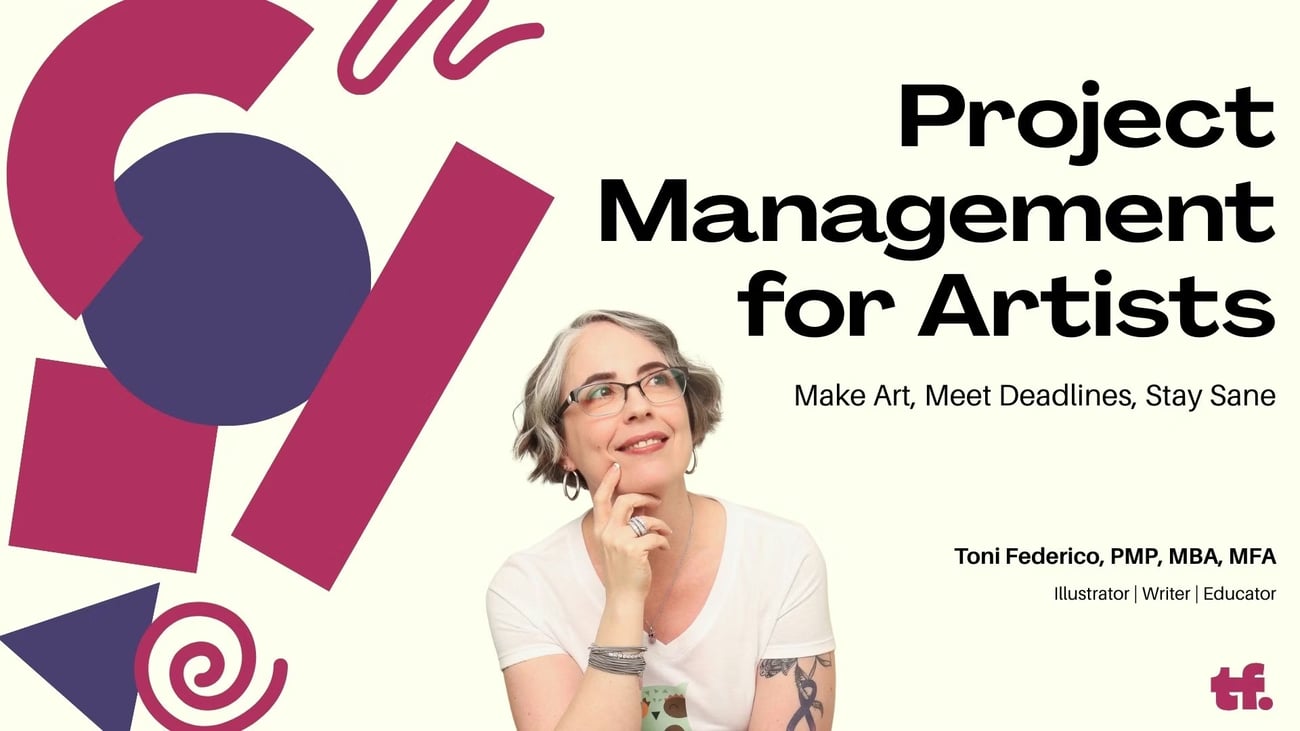
In March, we explored a topic at the intersection of your creative practice and your creative business: how to effectively pursue your goals through project management.
Our Ally Toni Federico is both a working artist and a formally-trained project manager with more than 30 years’ experience. In fact, she still works as a project manager in corporate and governmental institutions, balancing the demands of that consulting work with dedicated time for her own creative pursuits and art-based business.
When you think about it, so much of what artists do is inherently project-based, with a definite beginning and end. Some examples:
-
developing a pattern collection
-
negotiating a licensing deal
-
successfully completing a client assignment
-
hiring an assistant
-
painting a new series of original paintings
Each one unfolds over time, with moving parts, shifting priorities, and real deadlines. And as a self-employed artist, you’re left to figure out how to juggle it all—often all on your own.
Toni’s presentation helped us see project management as a form of support, self-care, and empowerment. Rather than relying on bursts of energy, last-minute pushes, or endless to-do lists, we looked at what it means to build systems that hold your work, so you don’t have to carry it all around in your head, or overwhelm yourself with complicated task management tools.
There was also an important undercurrent throughout the session: sustainability. This isn’t just about getting things done. It’s about getting them done in a way that allows you to:
-
take a break and return to your work with clarity
-
meet deadlines without panic
-
move between projects without losing momentum, or yourself, in the process
It’s not about doing more. It’s about creating the conditions that make your work more doable. Like so many conversations inside ABA, it left folks thinking not just about what they’re working on, but how they’re working.
Toni acknowledges that project management at a professional level can be kind of stiff and “hoity-toity” (i.e. the antithesis of creativity). But she uses her signature wry sense of humor and no-b.s. approach to translate corporate methods into something relatable for working artists. Throughout her talk, she gives examples that immediately resonate. She shows how this framework supports the complexity of a creative life without stifling vision and expression.
One lightbulb moment for many was Toni’s explanation of a “work breakdown structure” (a key concept in project management). For those of us who think of a “to do” list as effective project management, Toni gently helped us see how this approach masks the complexity of our work. She opened our minds to the many benefits of a phased-based project breakdown, showing how it differs from a “task list.”
For example, if you’re designing a fabric collection, your task list might look something like:
-
gather inspiration
-
sketch ideas
-
choose a color palette
-
develop hero print(s)
-
develop coordinates
Now take a few minutes to clearly visualize yourself sitting down to do just the first item on that list: gather inspiration.
You recognize right away this seemingly simple step is a complex process that might stretch across days or even weeks, referencing a huge variety of media and sources, requiring thoughtful curation and decision-making that’s relevant to the ultimate goal.
That’s because “gather inspiration” is not a task, it’s a phase with multiple layers. When those layers stay invisible, it’s very easy to underestimate the true scope of a project.
That insight connects directly to a few bigger themes in Toni’s presentation:
-
Pricing: If you’re not fully accounting for the work involved, it’s difficult to price it accurately.
-
Capacity: Without a clear sense of how long things take, it’s easy to overcommit.
-
Burnout: When projects expand quietly, your time and energy absorb the difference.
We also spent time looking at how projects unfold over time, moving from idea, to planning, to execution, to launch. Toni’s examples helped us see how much smoother that process becomes when the work is broken down into actionable steps and scheduled realistically.
Among the many practical shifts that stood out:
-
Defining and sticking to scope as a means of protecting your time rather than limiting your creativity
-
Scheduling specific actions instead of vague tasks (e.g. “refine motif for 2 hours” vs. “work on collection”)
-
Imagining potential risks—those unexpected things that can throw a schedule completely out-of-whack—and how you’ll address them.
-
Building in intentional buffer time, not just for delays, but for rest, reflection, and course correction
-
Closing the loop by taking time to document learnings and celebrating completion
Taken together, the conversation pointed to something simple but powerful:
Instead of seeing organization and systems as something that constrains creativity, we explored how they actually protect and nurture it.
The recording of Toni’s fantastic presentation is available to members on-demand in our replay library. Join the ABA anytime for access to this and dozens more!
|