Building a resilient business, and bringing art into community
 ‌ ‌ ‌ ‌ ‌ ‌ ‌ ‌ ‌ ‌ ‌ ‌ ‌ ‌ ‌ ‌ ‌ ‌ ‌ ‌ ‌ ‌ ‌ ‌ ‌ ‌ ‌ ‌ ‌ ‌ ‌ ‌ ‌ ‌ ‌ ‌ ‌ ‌ ‌ ‌ ‌ ‌ ‌ ‌ ‌ ‌ ‌ ‌ ‌ ‌ ‌ ‌ ‌ ‌ ‌ ‌ ‌ ‌ ‌ ‌ ‌ ‌ ‌ ‌ ‌ ‌ ‌ ‌ ‌ ‌ ‌ ‌ ‌ ‌ ‌ ‌ ‌ ‌ ‌ ‌ ‌ ‌ ‌ ‌ ‌ ‌ ‌ ‌ ‌ ‌ ‌ ‌ ‌ ‌ ‌ ‌ ‌ ‌ ‌ ‌ ‌ ‌ ‌ ‌ ‌ ‌ ‌ ‌ ‌ ‌ ‌ ‌ ‌ ‌ ‌ ‌ ‌ ‌ ‌ ‌ ‌ ‌ ‌ ‌ ‌ ‌

View in your browser

ABA logo image

Happy September, !


I’m back with another installment of Inside the Art Brand Alliance, our monthly glimpse into the conversations and professional development happening within the ABA.


Most recently, we’ve been thinking and talking about what makes an art business resilient—not in theory, but through the lived experiences of artists who’ve been at it for many years.


Then… be our guest at this month’s event! Join us to explore: what might it mean to bring your art and creativity into your local, real-life community? See free registration info below.


First, a peek inside our recent panel discussion…


Dip into the ABA Well 💦 Building a Resilient Art Business”—an ABA Panel Discussion

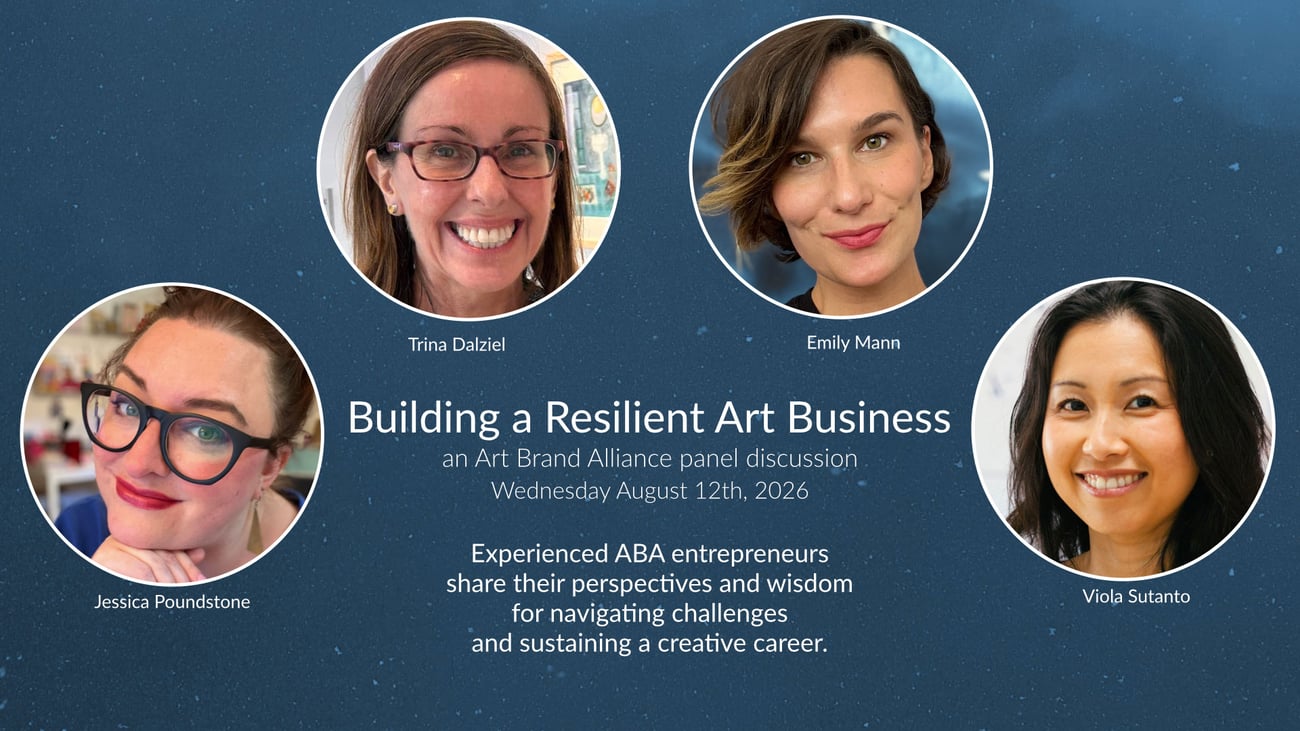
Building a resilient art business event graphic

What gives an art business staying power?


That was the question behind a recent conversation with our Allies Jessica Poundstone, Emily Mann, Viola Sutanto, and Trina Dalziel—four artists whose businesses look quite different from one another, and who collectively bring many decades of experience to the table.


This range of experience and business models is a key differentiator of the Art Brand Alliance community. It’s what lends depth to our conversations and this one was a perfect example.


Our panelists’ stories were sometimes about tenacity, sometimes about awkward transitions, sometimes about graceful acceptance. The common denominator was how these shifts were catalysts for growth, whether in the business itself or in the self-awareness and leadership skills of the artist (often both!). Here are a few examples:


Jessica talked about becoming quicker to recognize opportunities that are likely to go nowhere, and more protective of the time she gives them. She also shared that she’s become more disciplined about tracking her outreach, both to make follow-up easier and to remind herself (during those inevitable anxious stretches) of the work she’s already put into building new business.


Emily described learning to let go of clients and projects that aren’t a good fit, and the enormous difference hiring help has made to both her business and her well-being. Her studio now regularly looks at what’s selling, what’s profitable, what clients are asking for, and where the market itself may be changing. The data helps them stay flexible and proactive when once-reliable sources of revenue decline.


Viola shared a simple filter she uses whenever repetitive work starts piling up: Can we eliminate it? If not, can we automate it? And if not, can we delegate it? Learning to hand things off—even when someone else might do them differently than she would—has allowed her to grow without trying to personally hold every piece of the business.


And Trina, who has worked as a freelance illustrator for roughly three decades, talked about something so relatable: the challenge of making space for personal work while paid assignments keep calling. Experience has shown her that personal projects may or may not become meaningful revenue streams, but they can move your art and skills forward in unexpected ways, lead to a client or opportunity you couldn’t have predicted, or simply be the thing you would regret never trying.


Throughout the conversation, questions emerged. Here are some of the big themes our panelists explored:

  • How can you tell the difference between a temporary slowdown and a market shift that requires a real change?

    • One important tip shared repeatedly: Track your metrics over time so you have more objective evidence from your own specific business in addition to the wider news and stories from others.

  • When does hiring help become a responsible investment rather than an expense you can’t afford?

    • Panelists' answers looked at the fine line between hiring when the workload becomes unsustainable and hiring before you’re desperate, and different ways to thread that needle. 

  • How do you diversify revenue streams without scattering your attention in every direction?

    • I loved this perspective in particular: Try new things as experiments first, going slowly and lightly into any new potential offering. Only fold them into the business if they prove themselves.

  • And how do you make room for curiosity and creative evolution while still supporting yourself financially?

    • Many shared how important these “side quests” are to your creative and business health. Jessica has decided to call these “research and development”—a frame that gives them the legitimacy they deserve! 


Throughout this talk, we saw the many faces of resilience in business, plus a common denominator: the importance of staying connected to the parts of the work that bring genuine curiosity and joy.


When you join the ABA, you’ll be welcomed into a community where thoughtful conversations like this are the norm. It’s a place to touch base when you’re navigating something new or challenging in your business and need some outside perspective from other professionals. And it’s a place to share your own learnings and your wins, providing perspective for another Ally.


Invitation to be our guest this month! 🎟️ Community Art + Activism, a roundtable discussion

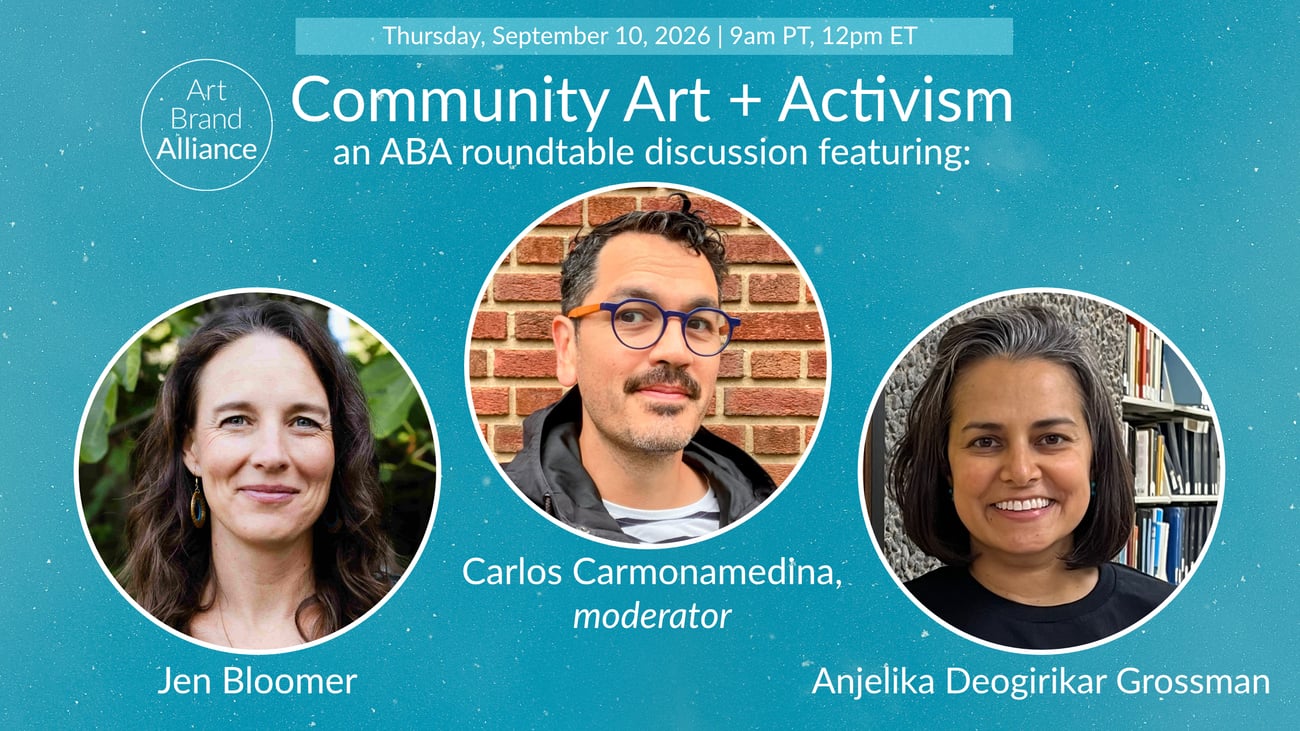
Community Art + Activism event graphci

Please join us for this exciting roundtable discussion.

Registration is free—we’d love to have you as our guest! Read on for details.


“Community art and activism” is a big idea that can feel at once inspiring and intimidating. What does it mean, in practical terms, for an individual artist?


In this discussion, we’ll gather with ABA members Jen Bloomer, Carlos Carmonamedina, and Anjelika Deogirikar Grossman—each of whom has woven community engagement into their art practice and business model.


Carlos is a visual artist and illustrator whose long-running The Culture Curious project documents Washington, DC neighborhoods through drawing, conversations with local residents, and archival research. He also organizes a local drawing club and collaborates with libraries and other community organizations.


Jen is an artist, muralist, and teacher whose work centers on human rights, human dignity, and human connection. For more than two decades, she has created art with people of all ages, building spaces where others can access their creative voices and connect with one another.


Anjelika is an educator, activist artist, and researcher interested in the intersection of culture, community building, and public policy. Her work asks how arts and culture might help build understanding and communities of belonging.


Together, they’ll help us make this expansive topic more concrete. We’ll learn about their respective approaches, hearing what “community” and “activism” look like in their own practices.


And we’ll invite you to explore the possibilities with us! If art and creativity are assets we can bring to our communities, what might that mean for each of us? How might an art practice both sustain the artist who makes the work and strengthen connections with the people and places around them?


There’s no expectation that everyone will arrive with an answer, or even identify with the word “activist.” This is an opportunity to hear several different approaches, bring your own experiences and questions, and explore what involvement might look like on your own terms.


We invite you to be our guest! 


Thursday, September 10, 2026
9:00–10:30am Pacific / 12:00–1:30pm Eastern


Free registration here: https://artbrandalliance.com/your-personal-aba-event-invitation (the password is ABAFRIEND).


Bring your curiosity, your own experiences, and your questions. We’re excited to meet you there.


About this series

Inside the Art Brand Alliance is a monthly email series designed to give prospective members like you a better feel for the trust, candor, and real-world examples members share inside our private professional network, while respecting the confidentiality that helps make those conversations possible.


Each month, I share a glimpse into a recent ABA conversation, event, or discussion, along with an invitation to something coming up next. If you'd like to explore previous issues of this newsletter, you can find the archive here.


And if you have questions about ABA membership, simply hit reply. I'd love to hear from you.


Warmly,


Betsy


Betsy Cordes

Founder/Director Art Brand Alliance

betsy@artbrandalliance.com

Art Brand Alliance on Instagram


Email Marketing by ActiveCampaign